


I’ve spent years helping college students build wardrobes that actually work for their lives — not their bank accounts. And the number one thing I hear over and over is the same fear: “I can’t afford to look put-together.”
Here’s the truth. Budget fashion for college students isn’t about spending less and looking worse. It’s about spending smarter and knowing a handful of tricks that stretch every dollar you have.
In this guide, I’m sharing the exact system I recommend to my clients and readers — one that gets you 10+ outfits from 5 pieces, a foolproof finals-week look, and the styling logic behind why certain combinations just work.
Quick Summary Table
| What You’re Solving | Quick Answer |
|---|---|
| Full outfit on a tight budget | Build around 3-4 solid-color basics, add one statement accessory |
| Small closet / dorm space | Use a 5-piece capsule wardrobe to create 10+ outfit combinations |
| No time to get ready | Keep one “emergency uniform” pre-decided and ready to grab |
| Making one item last | Style the same piece 3 different ways using accessories and layering |
| Best fabric for budget buys | Cotton blends — durable, versatile, and cheap to maintain |
Tools & Materials You Need
Before you start building a budget-friendly wardrobe, here’s your actual shopping checklist. No fluff, no filler — just what works.
- 3-4 solid-color basics (black, white, navy, or beige tops) — $5-10 each at thrift stores or budget retailers
- 2 versatile bottoms (one denim, one neutral trouser or legging) — $10-15 each
- 1 lightweight layering piece (denim jacket or cardigan) — $10-20
- 2-3 accessories (statement earrings, a scarf, a belt) — $3-8 each
- 1 pair of comfortable, multi-purpose shoes (white sneakers work with almost everything) — $20-30
Total starter budget: roughly $80-120 for a wardrobe that can produce 15+ outfit combinations.
Step-by-Step Guide to Building Your Budget College Wardrobe
Step 1: Audit What You Already Own
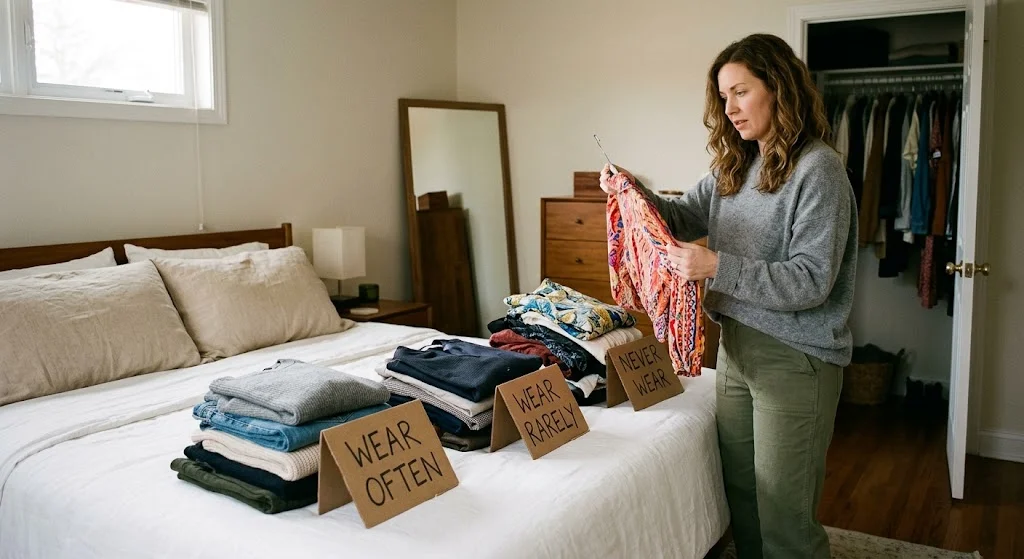
I always tell my clients to start here first, before spending a single dollar. Lay everything out on your bed and separate it into three piles: wear often, wear rarely, never wear.
That “never wear” pile is your hidden resource. Nine times out of ten, it’s not the item that’s the problem — it’s how it’s being styled.
Step 2: Build Around a Neutral Base
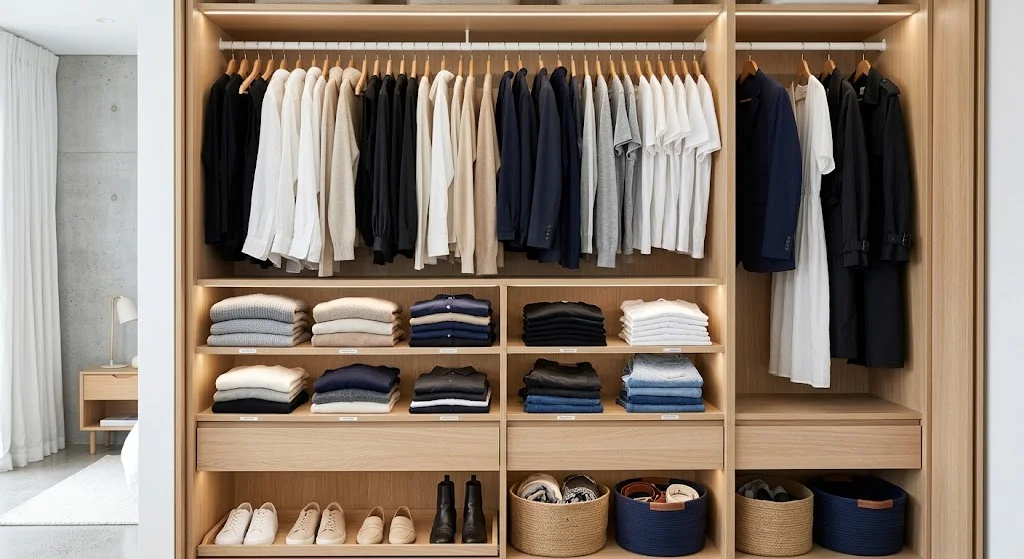
Pick 2-3 neutral colors and commit to them. Black, white, beige, and navy mix with almost anything, which means every new piece you buy works with everything else you already own.
This is the single biggest mistake I see students make. They buy trendy colors that only match one or two things, and end up with a closet full of clothes that don’t talk to each other.
Step 3: Master the 5-Piece, 10-Outfit Formula
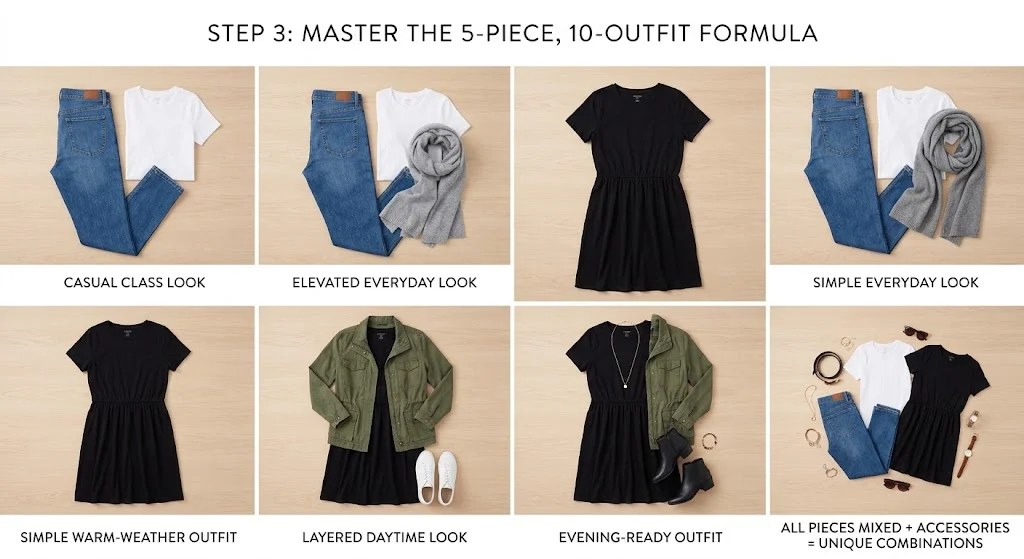
Here’s exactly how the math works:
- Jeans + plain top = casual class look
- Jeans + plain top + scarf = elevated everyday look
- Dress alone = simple warm-weather outfit
- Dress + jacket + sneakers = layered daytime look
- Dress + jacket + boots + jewelry = evening-ready outfit
- Top tucked into jeans + belt = polished daytime look
- Same top, untucked and loose = relaxed weekend look
- Cardigan over dress = cold-weather transition outfit
- Cardigan over top + jeans = layered casual look
- All pieces mixed with different accessories = 2-3 additional unique combinations
Step 4: Create Your “Emergency Uniform”

Pick one outfit — a comfortable dress, or leggings with an oversized top — and mentally lock it in as your no-decision-needed option for finals week or rough mornings.
I keep telling people this isn’t giving up on style. It’s decision fatigue management, and honestly, some of the best-dressed people I know have a version of this exact system.
Optical Tricks & Pro Styling Hacks
These are the small moves that make a $10 outfit look like $100.
- Tuck your top in on one side only (the “French tuck”) — instantly makes any outfit look more intentional
- Roll your sleeves to break up a plain silhouette without spending anything
- Add a belt at the natural waistline to create shape in oversized or thrifted pieces
- Stick to one statement piece per outfit — either bold jewelry or a bold bag, never both, so nothing competes for attention
- Match your shoe color to your bottom, not your top — this elongates your legs and makes budget shoes look more expensive
Surprising Facts & Science Behind Smart Styling
I like backing up styling advice with more than just opinion, so here’s what the research actually says.
- Color psychology data shows that neutral tones (black, white, navy) are processed by the brain as more “trustworthy” and “put-together,” which is why neutral-based outfits often read as more expensive than they are
- Vertical lines create a lengthening illusion — a phenomenon well documented in visual perception studies — which is why a single long cardigan or vertical stripe can make a budget outfit look more polished
- Fit affects perceived value more than fabric cost does, according to consumer behavior research — a well-fitted $10 top consistently outperforms a baggy $50 one in “expensive-looking” perception tests
- Repetition of a signature color or accessory builds personal brand recognition faster than variety does, which is exactly why capsule wardrobes work so well for building a recognizable personal style
Frequently Asked Questions
How much should a college student budget for a starter wardrobe? Around $80-120 is enough to build 3-4 basics, 2 bottoms, and a few accessories that combine into 15+ outfit options.
What’s the easiest way to make cheap clothes look expensive? Focus on fit and neutral colors first. A well-fitted $10 top in a neutral tone almost always looks more expensive than a baggy, brightly colored piece that costs three times as much.
How many outfits can I really get from a small dorm wardrobe? With 5 well-chosen basics, most people can build 10-15 distinct outfits by mixing tops, bottoms, layers, and accessories in different combinations.
What should I wear during finals week when I have zero time? Pre-decide one comfortable “emergency uniform” — a dress or leggings with an oversized top — and keep it ready so you never have to make a decision when you’re exhausted.
Final Thoughts
The best-dressed college students I’ve worked with aren’t the ones spending the most money. They’re the ones who understand their own wardrobe well enough to make five pieces work as hard as fifty.
Budget fashion for college students isn’t a compromise — it’s a skill. And once you build the habit of styling smart instead of shopping big, you’ll carry that skill with you long after graduation.
Start small. Pick your five pieces this week, and see how many outfits you can actually create. I promise you’ll surprise yourself.